Japan Income Threshold Simulator 2026–2027
Enter your annual employment income and every Japanese threshold — income tax, residence tax and social insurance — is checked at once. It covers the October 2026 repeal of the ¥1.06m wage requirement and the change to how the ¥1.3m test works from April 2026. Everything is calculated in your browser; nothing you type is sent anywhere.
Your details
What applies to you
Deductions for whoever claims you
These amounts assume the person claiming you has total income of ¥9m or less. Above that the spouse and special spouse deductions taper off, and above ¥10m they are unavailable.
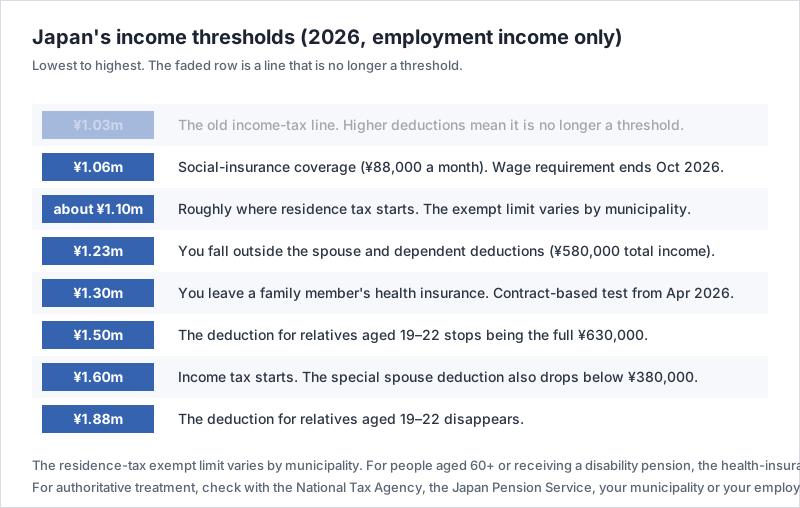
All the thresholds, and where you sit
| Income | What it is | At your income |
|---|---|---|
| ¥1.03m | The old income-tax line. Deductions were raised for the 2025 tax year, so this is no longer a threshold | — |
| ¥1.06m | Expanded social-insurance coverage (¥88,000 a month). This wage requirement is abolished in October 2026 | — |
| around ¥1.10m | Roughly where residence tax starts. The exempt limit varies by municipality | — |
| ¥1.23m | You fall outside the spouse and dependent deductions (total income ¥580,000) | — |
| ¥1.30m | You leave a family member's health insurance. Judged on contracted expected income from April 2026 | — |
| ¥1.50m | The special deduction for relatives aged 19–22 stops being the full ¥630,000 | — |
| ¥1.60m | Income tax starts. The special spouse deduction also stops being the full ¥380,000 | — |
| ¥1.88m | The special deduction for relatives aged 19–22 disappears | — |
| ¥2.016m | The special spouse deduction disappears | — |
What changes in 2026 and 2027
April 2026: how the ¥1.3m test works changes. Whether you count as a health-insurance dependant will be judged on the annual income expected under your employment contract rather than on what you actually received. Going over ¥1.3m temporarily through busy-season overtime is therefore less likely to remove you from dependant status straight away. The ¥1.3m figure itself does not change.
October 2026: the ¥1.06m wage requirement is abolished. Under the pension reform act passed in June 2025, the requirement to earn at least ¥88,000 a month drops out of the conditions for expanded social-insurance coverage. After that, the main test is whether your contracted hours are 20 or more a week, so keeping your income under ¥1.06m will no longer keep you out if you work 20 hours or more.
From October 2027: the employer-size requirement is lowered in stages. The current “51 or more staff” condition is due to fall step by step and eventually to be removed altogether, bringing people at smaller employers into coverage over time. This simulator judges on the current 51-or-more rule.
Why the ¥1.03m line became ¥1.6m
The fiscal 2025 tax reform raised the minimum employment income deduction from ¥550,000 to ¥650,000 and raised the basic deduction alongside it. For people with total income of ¥1.32m or less, the basic deduction is ¥950,000. The ¥650,000 employment income deduction plus the ¥950,000 basic deduction leaves taxable income at zero up to ¥1.6m, which is now the ceiling for paying no income tax on employment income.
The extra basic deduction for people with total income above ¥1.32m and up to ¥6.55m (¥880,000, ¥680,000 and ¥630,000) is a two-year measure covering the 2025 and 2026 tax years only, reverting to ¥580,000 from the 2027 tax year. The simulator reflects that difference according to the point in time you select.
How to use it, and what it does not cover
Enter your annual employment income, the point in time you want judged, your contracted weekly hours and your employer's headcount, and the income tax, residence tax, social insurance and dependant results all update together. The buttons fill in common income levels.
This is a guide for people whose only income is from employment. Deductions for social insurance premiums, life insurance premiums, iDeCo and the like, having more than one employer, or having income other than salary will all change the result. The residence-tax exempt limit varies by municipality. For people aged 60 or over, and for people receiving a disability pension, the health-insurance dependant limit is ¥1.8m rather than ¥1.3m. For authoritative treatment, check with the National Tax Agency, the Japan Pension Service, your municipality or your employer.
If you have side income from streaming or YouTube, the streamer revenue estimator can sketch out the annual total first, so you can check its effect on these thresholds here.
Frequently asked questions
When is the 1.06 million yen wage requirement abolished?
Under the pension reform act passed in June 2025, the wage requirement for expanded social-insurance coverage — pay of at least 88,000 yen a month, roughly 1.06 million yen a year — is due to be abolished in October 2026. After that the main test is whether your contracted hours are 20 or more a week. The employer-size requirement, currently 51 or more staff, is also due to be lowered in stages from October 2027.
What changes about the 1.3 million yen threshold in 2026?
From April 2026, whether you count as a health-insurance dependant is judged on the annual income expected under your employment contract rather than the income you actually received. Temporarily going over 1.3 million yen through busy-season overtime is therefore less likely to remove you from dependant status straight away. The 1.3 million yen figure itself does not change.
Why did the 1.03 million yen threshold become 1.6 million?
The fiscal 2025 tax reform raised the minimum employment income deduction from 550,000 to 650,000 yen and raised the basic deduction as well. For people with total income of 1.32 million yen or less the basic deduction is 950,000 yen. Adding the 650,000 yen employment income deduction to the 950,000 yen basic deduction leaves taxable income at zero up to 1.6 million yen, so that is now the ceiling for paying no income tax.
Is anything I type sent to a server?
No. Your income and the other inputs are calculated inside your browser only, and are neither transmitted nor stored.